Professional Educator Standards Board, legislatively required report: “The Potential of Micro-credentials in Washington State”
Author, October 2019
Leveraging the Professional Educator Standards Board’s (PESB) micro-credential pilots, this report explores micro-credentials as one option within Washington’s educator professional learning system. An innovative form of professional learning, a micro-credential is a performance-based assessment of a specific competency, providing an opportunity for educators to present evidence of their learning. Through the pilots, PESB discovered several lessons to address in future micro-credential structures and to consider in other professional learning innovations, including the importance of support structures, incentives, and connection to existing initiatives.
Click here to read the full report.
Political Science Senior Thesis: “The Politics of Capacity: No Child Left Behind”
Author, February 2016 (Awarded Cum Laude from WUSTL College of Arts and Sciences, and Grossman-Alexander Prize for outstanding senior honors thesis in American Politics)
I explore the conditions under which states decide to comply with federal intervention involving funding. I focus on the assessment component of No Child Left Behind (NCLB), legislation requiring states to create tests and report student achievement in order to receive federal education funds. I argue that both political indicators – governor partisanship, the election calendar, and teachers’ union strength – and compliance costs were central to NCLB compliance decisions. State wealth, Black and Hispanic/Latino populations, student achievement on exams, and state education funding from the federal government affect the cost of compliance, and therefore played a substantial role in decisions to comply. To test the relative influence of these political factors and measures of state capacity, I create an original dataset to test my hypotheses. Using logistic regressions, I find that capacity is significantly related to compliance, although student proficiency did not to play a role. Gubernatorial partisanship, teachers’ union strength, and the presence of an election year also demonstrated significant influence over the decision to comply. My findings suggest that compliance with perceived federal mandates is a function of both capacity and political consideration.
Click here to read the full thesis.
Studio Art Capstone: “Crossing the Divide: Art as Mediation and Pilgrimage ”
Author, May 2016
Founded on my personal experiences of growing up in an interfaith household and my high school semester abroad in Israel, my artistic practice seeks to build bridges between people, connecting diverse communities across divides (cultural, religious, economic, racial, ethnic etc.). Through two processes, mediation and pilgrimage, specifically in using myself as an active participant, I argue that the process of making can become the neutral ground in which to build relationships and begin to imagine coexistence. Mediation is expressed by Homi Bhabha’s definition of negotiation: “The ability to articulate differences in space and time…to intervene in the forest of signs and mediate what may seem to be incommensurable values or contradictory realities,” and specifically involves collaboration with Washington University in St. Louis alumna, my friend, Ayesha Mohyuddin. Pilgrimage to self is defined as self-implication, a journey back into personal and historical memory to move forward, gaining an awareness of my own participation in systems of oppression.
Click here to read the full capstone.
Municipal Court White Paper
Coauthor, August 2014
ArchCity Defenders released a whitepaper report in August 2014 regarding the use of St. Louis Municipal Courts as a large source of town revenue. When summoned to these courts, defendants frequently face jail as a result of their inability to pay court costs and fines when they plea guilty. As an important income stream, the Courts use the threat of jail to collect the outstanding fines. Yet, these municipalities fail to provide lawyers for those who cannot afford counsel. Courts also fail to make formal assessments of an individual’s ability to pay, in clear violation of Missouri Law. Upon revocation of probation because of their inability to pay, defendants are sentenced to jail or are arrested on warrants issued simply because of their lack of funds. ArchCity Defenders hope through a formal whitepaper report, the population’s constitutional rights will be upheld, and the municipalities will come to realize that running their courts as a source of income is both financially inefficient and detrimental to their communities. Since being released, the report has been cited in a variety of news sources including the New York Times, the Washington Post, the Huffington Post, USA Today, NBC News, Newsweek, and Bloomberg Business Week.
Click here to read the full report.
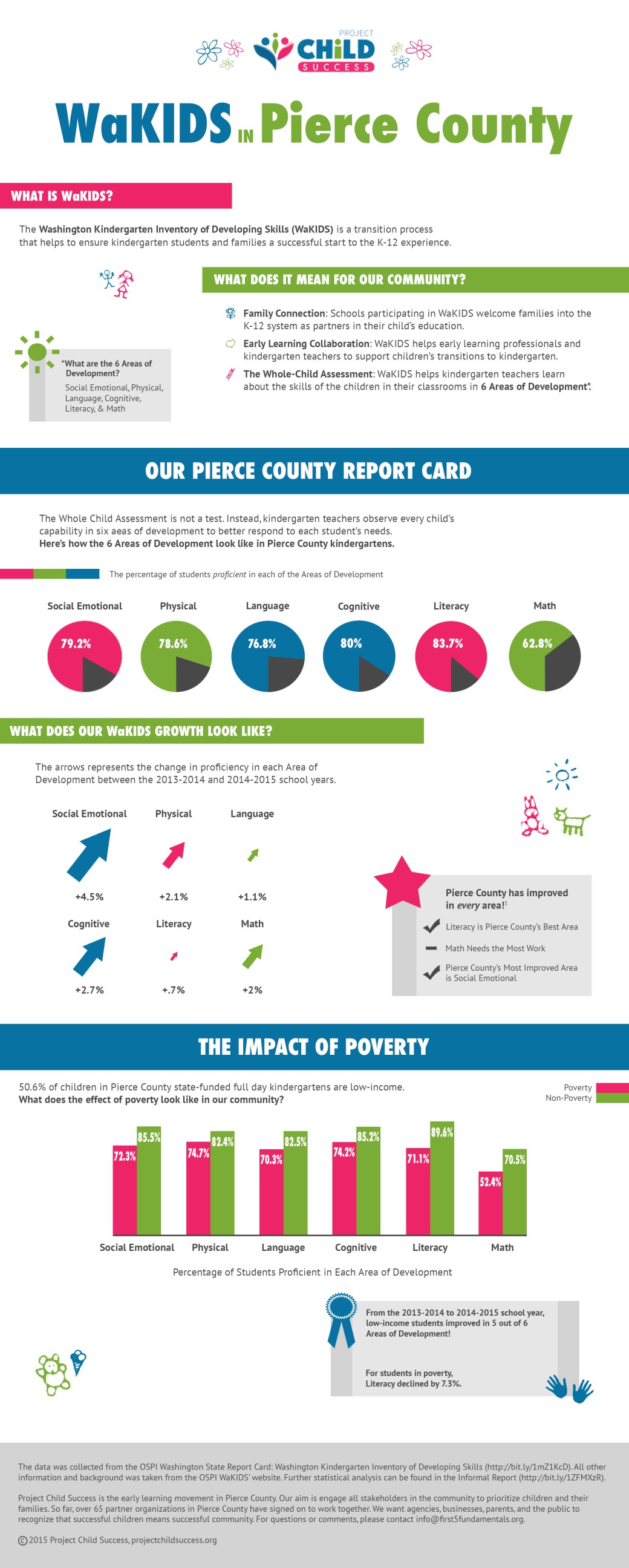
WaKIDS in Pierce County
Author, August 2015
The WaKIDS in Pierce County project serves as a preliminary assessment of the Washington Kindergarten Inventory of Developing Skills (WaKIDS) data in Pierce County. WaKIDS is “a transition process that helps to ensure a successful start to the K-12 experience and connect the key adults in a child’s life.” The data was aggregated from the district level to discern total number of students, Pierce County averages, and more. For full statistical analysis and methodology, click here for the informal report.
 Sophia Keskey